
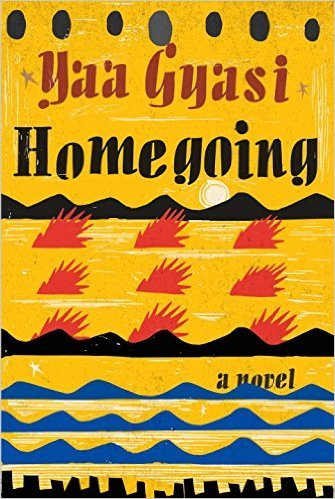
Homegoing begins in 18th-century Ghana with two half-sisters who never know each other. One marries a British colonial governor and lives in comfort in Cape Coast Castle; the other is imprisoned in the very same castle's dungeons and sold into slavery in America. From there, the novel follows their descendants across eight generations, from the Gold Coast to Mississippi plantations, from the American Civil War to Jazz Age Harlem, illuminating slavery's long and troubled legacy on both sides of the Atlantic.
My Review
We believe the one who has power. He is the one who gets to write the story. So when you study history, you must ask yourself, Whose story am I missing? Whose voice was suppressed so that this voice could come forth? Once you have figured that out, you must find that story too. From there you get a clearer, yet still imperfect, picture.
I have just read three hundred pages that felt like three hundred years, and I mean that as the highest possible compliment.
Homegoing begins with two half-sisters in 18th-century Ghana who will never know each other. Effia marries an Englishman and lives in the grand rooms of Cape Coast Castle. Esi is imprisoned in the dungeons beneath those same rooms and sold into the transatlantic slave trade. From that single, devastating irony, Yaa Gyasi builds a family saga spanning seven generations and fourteen perspectives, tracking the descendants of both sisters across centuries of colonial Ghana and American history, from tribal wars and slave ships to the Fugitive Slave Act, coal mines, jazz clubs, and the present day.
What I know now, my son: Evil begets evil. It grows. It transmutes, so that sometimes you cannot see that the evil in the world began as the evil in your own home.
I usually grumble when a novel asks me to follow more than two perspectives. I did not grumble once here. Each chapter belongs to a new character, and not one of them felt thin or rushed, which is frankly astonishing considering the scope. Gyasi is a storyteller who understands that history becomes visceral only when it lives inside a specific human body, a particular face, a conversation overheard in a specific room. She never loses sight of that, not across three hundred years, not across fourteen lives.
The violence is honest and unflinching, as it must be, but it is never gratuitous. Gyasi handles her material with a sensitivity that keeps the horror in its proper place: as context for the people, not spectacle in place of them.
You cannot stick a knife in a goat and then say, “now I will remove my knife slowly - so let things be easy and clean; let there be no mess.” There will always be blood.
What I keep thinking about is the audacity of the structure and the fact that it works completely. Most family sagas follow three generations. This one follows seven, covers two continents, and somehow still feels intimate. I have no idea how she did it in three hundred pages. I am just grateful she did.
No one forgets that they were once captive, even if they are now free.
A genuine masterpiece. Five stars.
If we go to the white man for school, we will learn the way the white man wants us to learn. We will come back and build the country the white man wants us to build. One that continues to serve them. We will never be free.