

Minor Detail begins in the summer of 1949, one year after the war Palestinians mourn as the Nakba. Israeli soldiers murder a Bedouin encampment in the Negev desert, capture a young Palestinian woman, rape and kill her, and bury her in the sand. Decades later, a young woman in Ramallah stumbles across a brief account of this crime and becomes obsessed with uncovering its details, not least because it was committed exactly twenty-five years to the day before she was born. Told in two parts, in two radically different voices, the novel is a meditation on violence, memory, and what it costs to go looking for a truth that has been deliberately buried.
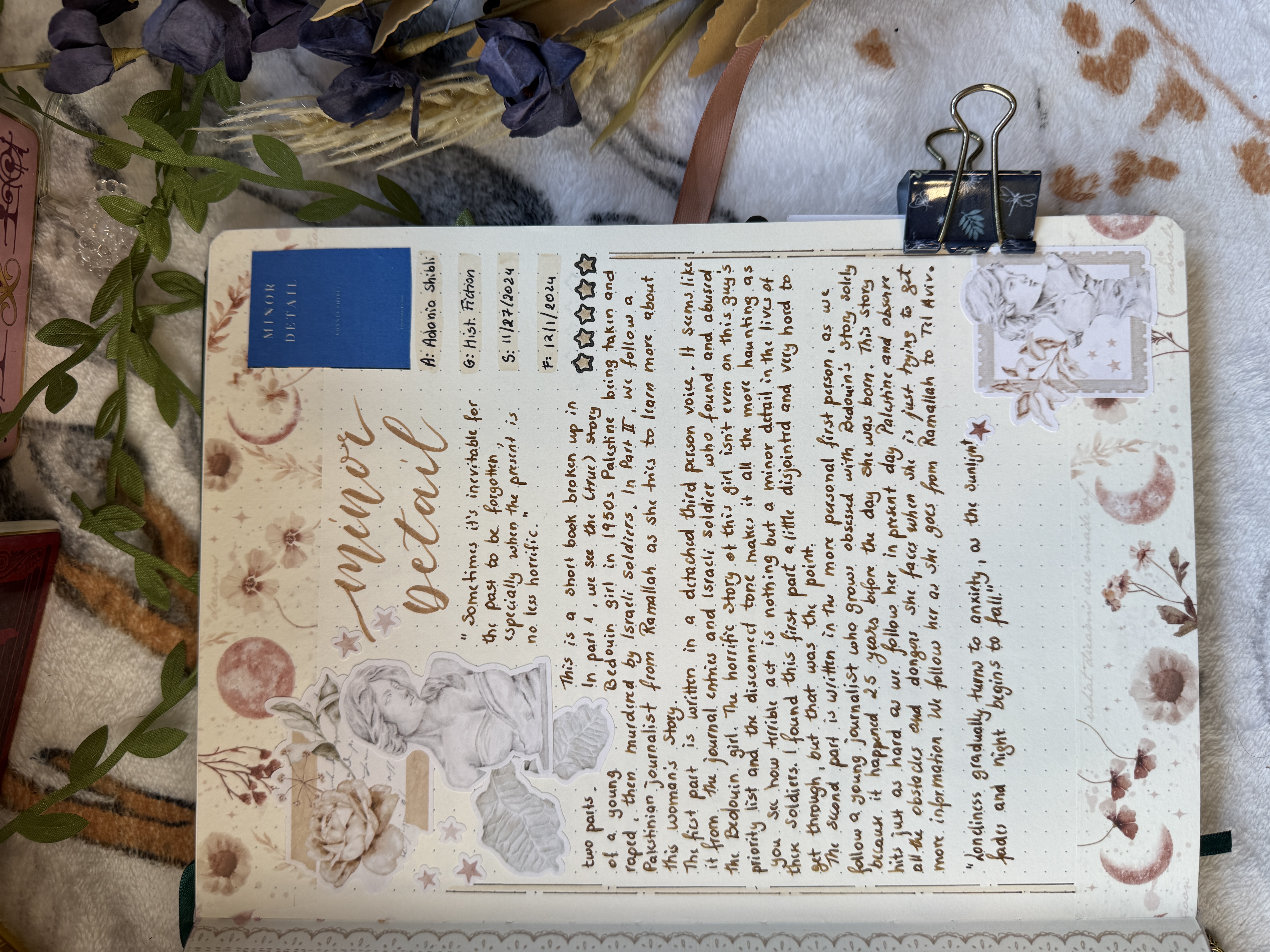
My Review
I finished this novella, closed the book, and sat in silence for a while. I am still not entirely sure I can explain why it affected me the way it did. That uncertainty feels like part of the point.
Minor Detail is divided into two halves. The first is set in 1949, following an Israeli platoon surveying the newly established border with Egypt in the days after the Nakba. Shibli renders the commander’s daily rituals, his washing, his dressing, the tending of a festering wound, in obsessive, repetitive detail. The effect is strange and quietly suffocating. When the violence comes, it arrives inside that same flat, matter-of-fact prose, which makes it more disturbing rather than less. The second half moves to the near-present and follows a young Palestinian woman in Ramallah who becomes fixated on this historical crime after discovering a brief account of it. Her attempt to investigate is met at every turn by the bureaucratic and physical architecture of occupation: checkpoints, restricted archives, the wrong identity card.
What Shibli does with structure is what stays with me. The motifs of the first half, the barking dog, the water, the sand, the border, migrate into the second, creating a pattern of repetition that feels less like literary technique and more like historical inevitability. The past is not past. It simply recurs.
My one reservation is the festering wound that shadows the commander throughout the first half. I read it eventually as a symbol of spreading corruption, which works, but it flirted at times with suggesting that the violence required an external cause, a kind of poison in the body. I think the novel is stronger when it implies that such acts need no excuse at all.