
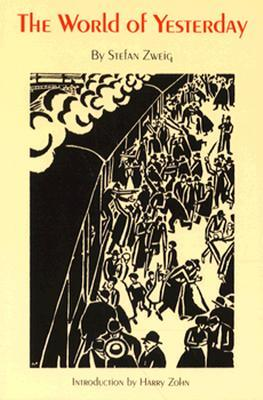
A memoir unlike any other, The World of Yesterday is Stefan Zweig's farewell to a vanished Europe. Written in exile as the world he loved collapsed around him, it is part elegy, part warning, and part love letter to the cosmopolitan culture of Vienna and the international community of artists he believed could save civilization from itself.
My Review
Stefan Zweig mailed the manuscript of The World of Yesterday to his publisher just days before he and his wife took their lives in Brazil in 1942. Knowing that context before you read a single page changes everything. This is a memoir written by a man who had already decided it was the last thing he would ever write, and it reads that way: luminous, mournful, and utterly without illusion.
What makes this book so unusual is that it isn’t really about Zweig. He barely appears in it as an emotional subject. Instead, he turns his gaze outward, toward Vienna in the last gilded years of the Austro-Hungarian Empire, toward the web of friendships he built with Rilke, Rodin, Verhaeren, Romain Rolland, and Freud, and toward the slow, agonizing dismantling of the cosmopolitan Europe he believed in with his whole heart. He watched Rodin work in his studio. His early writings were published by Theodor Herzl. He was at the center of an extraordinary cultural world, and he knew it, and then he watched it burn.
The grief in these pages is enormous, but it never collapses into self-pity. Zweig was constitutionally modest, almost to a fault, and what devastates you isn’t his anguish but his precision. He describes the rise of censorship, of hatred, of nationalism with the clarity of someone who saw it coming and could not stop it. The passages on Hitler’s rise are chilling. He traces how complacency enabled catastrophe, how ordinary people trusted their governments past the point of reason, how the arts were among the first targets. Reading those sections in 2026, I kept putting the book down. The pattern he describes, book bans, the scapegoating of minorities, the erosion of press freedom, the way economic anxiety gets redirected into hatred, felt less like history and more like a dispatch from the present.
Nationalism emerged to agitate the world only after the war, and the first visible phenomenon which this intellectual epidemic of our century brought about was xenophobia; morbid dislike of the foreigner, or at least fear of the foreigner.
Zweig dreamed of Europe as an international cultural community, one where artists across borders would hold the line against intolerance together. That dream died with him. But what haunts me is that he would not be surprised by where we are now. He’d already seen how quickly the thin crust of civilization can crack.
I finished this book feeling turned inside out. It’s a lament for a dead world and a warning about how worlds die. The fact that so much of it remains achingly relevant in the 21st century would not have surprised Zweig at all, and that might be the most devastating thing about it.
For anyone who cares about the relationship between culture, freedom, and political violence, this is essential reading.
For I have indeed been torn from all my roots, even from the earth that nourished them, more entirely than most in our times. I was born in 1881 in the great and mighty empire of the Habsburg Monarchy, but you would look for it in vain on the map today; it has vanished without trace. I grew up in Vienna, an international metropolis for two thousand years, and had to steal away from it like a thief in the night before it was demoted to the status of a provincial German town. My literary work, in the language in which I wrote it, has been burnt to ashes in the country where my books made millions of readers their friends. So I belong nowhere now, I am a stranger or at the most a guest everywhere. Even the true home of my heart’s desire, Europe, is lost to me after twice tearing itself suicidally to pieces in fratricidal wars. Against my will, I have witnessed the most terrible defeat of reason and the most savage triumph of brutality in the chronicles of time. Never—and I say so not with pride but with shame—has a generation fallen from such intellectual heights as ours to such moral depths