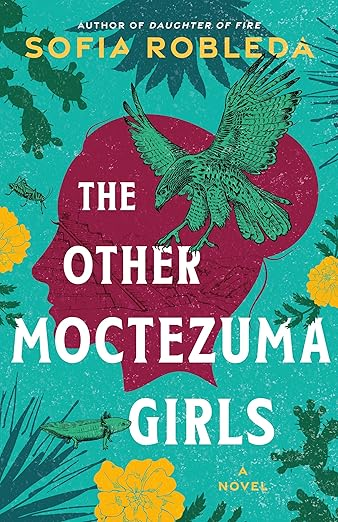
The Other Moctezuma Girls is set in Tenochtitlan in 1551, thirty years after the Spanish Conquest. When the last Aztec empress dies and her contested will threatens to tear her family apart, her daughter Isabel suspects a hidden account of her mother's life is scattered in clues across the Valley of Mexico. Joined by her siblings and a young cook named Juan, Isabel sets out on a perilous journey through viceroyal courts, mystical chinampas, and harsh terrain to piece together who her mother really was and what she sacrificed to survive.
My Review
In a world where the stories of women are so often erased, I am grateful this one exists.
Sofia Robleda has written a novel that pulled me in so completely that I spent the days after reading it deep in rabbit holes: googling maps of Tenochtitlan, reading about chinampas, tracing the lineage of Mexica rulers, and trying to understand the full weight of what the Spanish Conquest actually destroyed. That is the mark of historical fiction doing exactly what it should.
The story follows Isabel, daughter of Techuipochtzin, the last Aztec empress, who suspects that her recently deceased mother left behind a hidden account of her life, scattered in clues across the Valley of Mexico. What follows is part quest, part excavation of a woman history chose not to preserve. And as Isabel and her siblings piece together their mother’s journal, the picture that emerges is shattering: six marriages, an almost certainly non-consensual relationship with Hernán Cortés himself, seven childbirths, plague, conquest, forced conversion, and the erasure of everything she had ever known. Reading those journal entries, I kept returning to one line that stopped me cold: “Was true happiness possible if one never had a choice, a say in one’s life?”
The dual timeline and dual perspective could have been unwieldy, but Robleda handles it with confidence. Isabel is fierce and headstrong, her younger sister Catina quietly resilient, her older brother Nano all warmth and protectiveness. The sibling dynamics are sometimes funny, often deeply moving, and always feel true. The Nahuatl names take a little adjustment early on, but the family chart helps, and more importantly, the names matter. Identity is at the heart of everything here, and Robleda is not willing to sand down its edges for convenience.
But one thing that always makes me smile, now, laugh even, is the notion that the Spaniards conquered us. Oh, they sat, it only took five hundred men to conquer the Mexica, as if their thousands of Indigenous allies had been as useful as clouds of dust. It only took a year, they say. And I laugh, even now, I laugh at their bold-faced stupidity. For it was not those men who conquered us. No, it was the hueyzahuatl, the great pestilence they brought.
This is a raw, unflinching, and essential piece of historical fiction. The audiobook, for what it’s worth, is phenomenal. Five stars.