
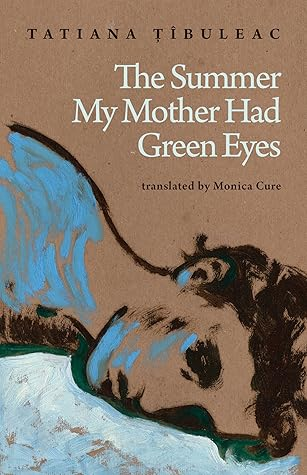
Eighteen-year-old Aleksy spends what he expects to be a torturous summer in the French countryside with his dying mother, only to find the woman he'd built his identity around hating slowly disappearing, replaced by someone softer and startlingly human. Fourteen years later, prompted by his psychiatrist, he relives those three months to make sense of the guilt, grief, and fragile reconciliation that defined them. It's a quiet, unsparing look at how families fail each other and the narrow window we sometimes get to make it right.
My Review
I went into The Summer My Mother Had Green Eyes expecting something in the vein of Claire Keegan or Elena Ferrante, and Țîbuleac does share that unflinching, unsentimental quality with both writers. What I didn’t expect was how hard it would be to sit with Aleksy’s voice for the first fifty pages or so.
He hates his mother, viscerally. It took me a while to understand this wasn’t teenage sulking but something closer to a soul-deep wound, the residue of a family gutted by his sister’s death and a mother too swallowed by her own grief to raise the son she had left.
The structure is what got me in the end. Aleksy essentially watches his mother die twice that summer in the French countryside: once from the cancer eating her body, and once as the woman he’d spent his life resenting quietly falls away, revealing someone softer underneath, maybe the mother she was always meant to be before grief hollowed her out. He finally gets what he wanted, just decades too late and only for a handful of months.
Țîbuleac writes about the things families don’t say out loud, how bottling up pain curdles into bitterness, how anger is so often just grief wearing a more socially acceptable mask. There’s a real intelligence in how she traces transgenerational trauma here, the way a mother who was failed can go on to fail her own child without ever meaning to.
I’ll be honest, I never fully warmed to either of these characters, and that distance kept me from loving this one. But the prose is really beautiful, veering between abstract, image-heavy passages and blunt gut-punches, and I can’t deny how much feeling she gets onto the page. This is for readers who want literary fiction that sits in discomfort rather than resolving it neatly.